
Review the Skills
Common Core Standard: RL.7.3
Analyze how setting, characters, and plot interact.
Explain how a character’s choices influence events.
Q: How do setting, characters, and plot work together?
A: The setting is when and where a story happens. The characters respond to problems in that setting. Their decisions help shape the plot, or sequence of events.
For example, a crowded train station might make a character feel rushed. If the character boards a train without checking its destination, that decision creates a new problem.
Ask yourself:
How does the setting create opportunities or difficulties?
What do the characters want?
How do their thoughts, words, and actions reveal their traits?
How do their choices cause later events?
Q: How is a plot usually organized?
| Plot element | What it does |
|---|---|
| Exposition | Introduces the characters, setting, and situation |
| Rising action | Develops the conflict through complications |
| Climax | Presents a turning point when an important action or decision changes the conflict |
| Falling action | Shows the results of that turning point |
| Resolution | Shows how the central conflict ends |
Reading and Guided Questions
Read the story. Then answer Questions 1–3.
The Last Crate
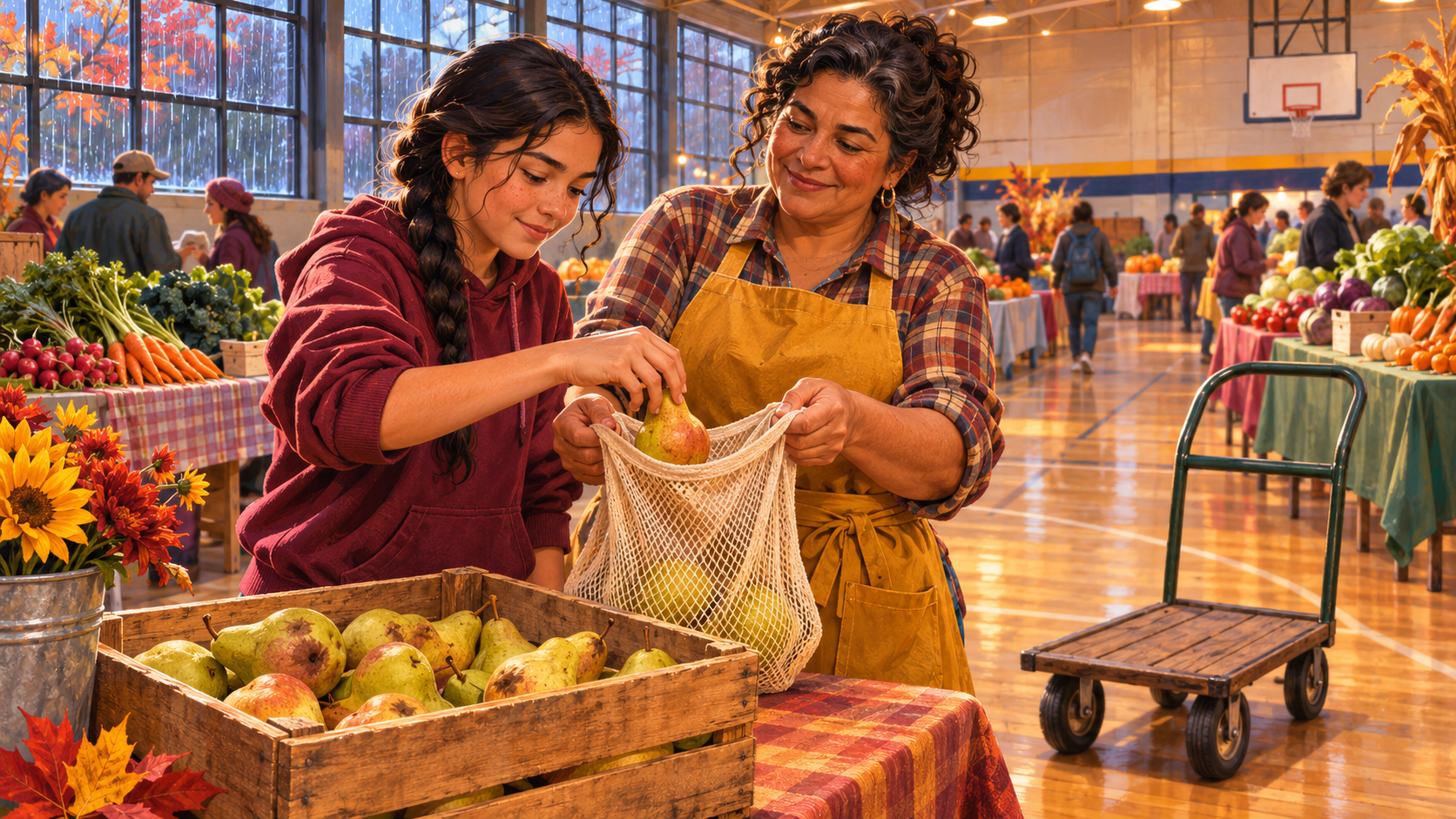
1. Rain drummed against the school gym’s windows as June straightened the pears on her aunt’s market table. The outdoor harvest market had moved indoors that morning. Now shoppers crowded between vegetable stands, and every sound bounced off the high ceiling.
2. June had begged to help Aunt Rosa sell produce. At thirteen, she was tired of being assigned little jobs while adults handled everything important. Today, however, her aunt kept offering reminders.
3. “Keep the ripe pears on top. Don’t stack them too high. And use the cart for the heavy crates.”
4. “I know,” June said, although she had never worked at the market before. She tugged the sleeves of her burgundy sweatshirt over her wrists and rearranged a pear that did not need rearranging.
5. By noon, only one full crate remained behind the table. Aunt Rosa turned to answer a customer’s question. June saw her chance to prove that she could manage without instructions. The cart stood several steps away, partly blocked by a shopper’s umbrella. Carrying the crate would be faster.
6. She lifted it. For three steps, everything went well. Then a family entered the narrow aisle, and June twisted sideways to let them pass. The crate tilted. Pears rolled across the gym floor like marbles.
7. Aunt Rosa hurried over. “Are you hurt?”
8. June shook her head. People were watching. She knelt to gather the pears, wishing the floor would open beneath her. Several fruits had split. Others had dark patches where they had struck the wood.
9. “I’ll put the damaged ones underneath,” June whispered. “Maybe people won’t notice.”
10. Aunt Rosa set down the empty crate. “Would that be fair to someone buying them?” Her voice was quiet, but June felt the question more sharply than a scolding.
11. June held a bruised pear in her palm. She could hide the damage and hope to escape another lecture. Instead, she placed it beside the split fruit. “No,” she said. “Can you help me sort them?”
12. Together, they separated the pears. The split ones went into a compost bucket. The bruised but usable ones could be sold at a lower price for baking. June explained the difference to each customer while Aunt Rosa held the bags open.
13. A man buying pears for a pie thanked June for pointing out a soft spot. Soon, the crate was almost empty. June fetched the cart to move their remaining supplies, even though carrying them would have been quicker.
14. As they packed up, Aunt Rosa handed her the money box. “Will you count today’s sales?”
15. June looked up. “You still trust me?”
16. “You made a mistake,” her aunt said. “Then you helped make it right.”
17. June opened the box. This time, when she was unsure where to begin, she asked.
1. Which words best describe June at the beginning of the story?
A. Careless and uninterested
B. Eager and defensive
C. Patient and confident
D. Lonely and withdrawn
2. How does the indoor market setting contribute to June’s problem?
A. The crowded aisle makes carrying the crate more difficult.
B. The cold temperature damages the pears.
C. The poor lighting prevents June from seeing the cart.
D. The market closes before June can sell anything.
3. Why does June suggest putting the damaged pears underneath the others? Support your answer with two details. (3 points)
1st detail
2nd detail
Learn from the questions
Expand examples and answers
Question #1: Identifying character traits
The correct answer is B. June begs to help because she wants responsibility, showing eagerness. Her response, “I know,” and her irritation with reminders show that she is defensive about her lack of experience.
Question #2: Connecting setting and plot
The correct answer is A. The narrow, crowded aisle forces June to turn while carrying the crate. This movement causes the pears to spill. The setting directly affects the action.
Question #3: Explaining a character’s motivation
Effective response:
June wants to hide the damaged pears because she is embarrassed and wants to avoid more criticism. She notices people watching after the spill, and paragraph 11 explains that she hopes to escape another lecture.
Incomplete response:
June puts them underneath because she feels bad.
The effective response identifies June’s motivation and supports it with specific evidence.
Try It On Your Own
4. What is June’s central internal conflict?
A. Whether to admit her mistake or conceal its consequences
B. Whether to sell pears or vegetables
C. Whether to leave the market before lunch
D. Whether to work indoors or outdoors
5. Which event is the story’s main turning point?
A. Rain forces the market indoors.
B. Aunt Rosa answers a customer’s question.
C. June chooses honesty and asks for help sorting the pears.
D. Aunt Rosa gives June reminders about stacking fruit.
6. Explain how June’s response to advice changes between the beginning and ending. Use evidence from both parts of the story. (3 points)
Remember: Identify a character’s choice, then explain what happens because of it.
Answer Key
Expand examples and answers
1. B — Eager and defensive.
2. A — The crowded aisle makes carrying the crate more difficult.
3. Sample response:
June wants to hide the damage because she is embarrassed and fears more criticism. She notices people watching after the spill, and she considers hiding the pears to escape another lecture.
4. A — Whether to admit her mistake or conceal its consequences.
5. C — June chooses honesty and asks for help.
6. Sample response:
At first, June responds to reminders with “I know” and ignores the instruction to use the cart. By the ending, she uses the cart and asks how to begin counting the sales. She has become more willing to accept guidance.
Three-point responses: Award one point for a clear explanation and one point for each of two relevant supporting details.
Test-Taking Tips
Use evidence to identify character traits.
Look closely at what a character thinks, says, and does. Then choose a trait that fits those details. Check whether the character behaves differently by the ending.
Follow the conflict through the plot.
Ask what the main character wants and what stands in the way. Identify the complications, the turning point, and the results. Remember that the climax changes the direction of the conflict; falling action shows what happens afterward.
Explain how the setting affects events.
Identify when and where the story happens, then go further: How do the surroundings influence a character’s choices or feelings? Connect a specific setting detail to its effect.
Connect character change to theme.
Compare the character’s choices at the beginning and ending. Ask what message about life those changes support. Express the theme as a complete idea and check it against several story details.
Remember: Strong responses explain connections. Use this pattern: story detail → effect on the character → effect on events.