
Build Your Skills
Q: How are narrative point of view and a character’s viewpoint different?
A: Narrative point of view concerns who tells the story and which thoughts or information the narration reveals. A character’s viewpoint includes that character’s knowledge, beliefs, and interpretation of events. A third-person narrator may stay close to one character or reveal information beyond that character’s experience.
Q: How do differences in knowledge create suspense or humor?
A: Suspense can arise when readers lack an important explanation—or when they know about an approaching event that a character does not. Humor may come from the gap between a character’s confident interpretation and the ordinary truth. Dramatic irony occurs when readers or an audience know something important that a character does not. It can create humor, suspense, or sadness.
| Ask yourself | Look for |
|---|---|
| What does the character know? | Observations, reports, and conversations |
| What does the character assume? | Conclusions that may exceed the evidence |
| What does the reader know? | Information the narration has supplied |
| What effect results? | Anticipation, concern, surprise, or amusement |
Read and Practice
Directions: Read the story. Then answer Questions 1–3.
The Secret Ingredient
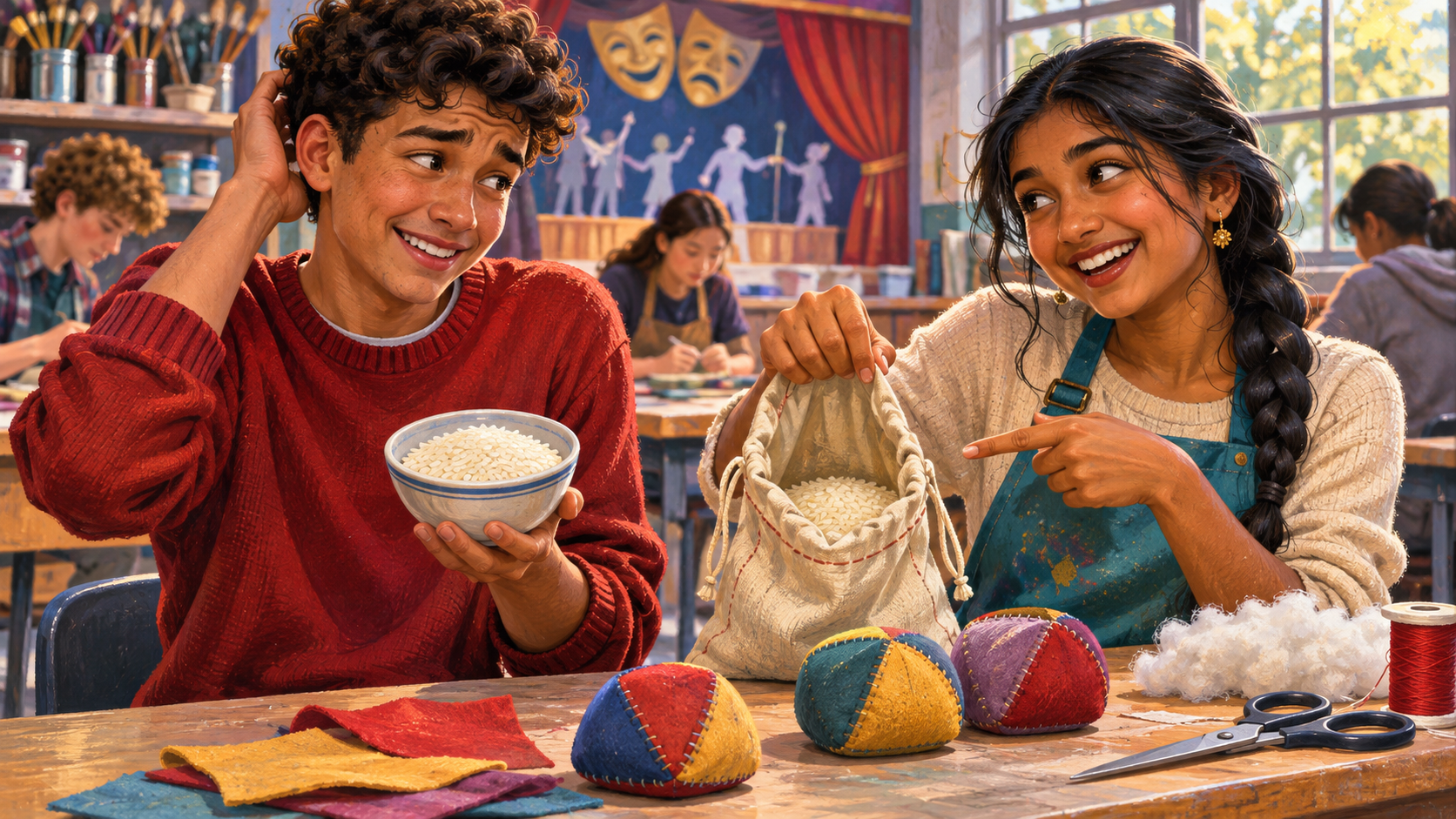
1. Evan arrived at the school’s Make-and-Take workshop carrying a bag of dry rice. Priya had asked him to bring it, along with a bowl and a spoon. He had skipped his afternoon snack. Whatever they were making, he intended to sample it.
2. Inside the art room, students wore aprons around tables covered with bright cloth. Evan spotted funnels, measuring cups, and several bowls. His guess seemed confirmed.
3. “You’re just in time,” Priya said. “We need the filling.”
4. Evan poured rice into a bowl. “Sweet or savory?”
5. Priya was leaning over a sewing machine and did not hear him. Across the room, a volunteer cut circles from purple fabric.
6. Evan considered the circles. Perhaps they were reusable napkins. This workshop was clearly more elaborate than he had expected.
7. “Don’t overfill them,” Priya told another student. “They need a little space to move.”
8. Evan nodded knowledgeably. His aunt said the same thing about dumplings. He was less certain about the fabric, but perhaps it was used to shape whatever they were preparing.
9. Priya disappeared into the supply cupboard. Evan examined a small, rounded object on her chair. It looked like a particularly sturdy pastry, although the stitches around its edge presented a puzzle.
10. When Priya returned, he lifted the bowl. “Should I start soaking this?”
11. “Please don’t.”
12. “Then how long does it cook?”
13. Priya looked at him, then at the rice. A smile spread across her face. She held open a partly sewn cloth pouch and positioned a funnel in its opening.
14. “Evan, we’re making juggling bags.”
15. The measuring cups, cloth circles, and stitched object rearranged themselves in his mind. Nothing in the room had changed except his explanation of it.
16. “So there isn’t a snack?”
17. Priya handed him the spoon. “There will be, if you brought one.”
18. Evan helped fill three bags and learned to stitch their openings closed. When he attempted his first juggling pattern, one landed on the table and another dropped into his empty bowl.
19. “Perfect,” he said. “Dinner is served.”
Questions
1. Whose understanding most closely guides the reader’s experience before the explanation?
A. The workshop volunteer’s
B. Evan’s
C. Priya’s
D. Evan’s aunt’s
2. What chiefly creates the humor?
A. Priya deliberately destroys Evan’s supplies.
B. The workshop has no practical purpose.
C. Evan interprets craft materials as evidence of cooking.
D. Every participant misunderstands the instructions.
3. How does limiting information to Evan’s understanding help create anticipation and make the reveal effective? Use at least two details. (3 points)
Study the Responses
Expand examples and answers
Question 1: The answer is B. Readers follow Evan’s observations and explanations. Priya’s purpose is not directly revealed until she names the project.
Question 2: The answer is C. The bowls, rice, and aprons fit more than one explanation, but Evan confidently selects the wrong one.
Question 3 — Effective response: Readers encounter clues through Evan’s expectations. He thinks cloth circles might be napkins and compares the filling process with making dumplings. Because the narration does not reveal Priya’s plan early, readers must interpret these clues. Naming the juggling bags suddenly gives the materials a different, consistent explanation.
Response needing revision:
The ending is surprising because Evan is surprised. This needs evidence and an explanation of how information is controlled.
Apply the Skills Independently
Directions: Read the story. Notice what readers know before Lila does. Then answer Questions 4–6.
The Knock Before Closing

1. At five forty, Lila watched rain slide down the library windows. Her astronomy-club entry was due online at six. The photograph needed to show the finished model, and hers was still missing its frame.
2. The model was a hanging solar system made of painted paper planets. Earlier that afternoon, its lightweight support had bent while she was carrying it into the library. Volunteer Mr. Ames had offered to straighten and reinforce it in his nearby workshop.
3. “Do what you can,” Lila had told him. Now she wished she had asked how long that might take.
4. Behind the desk, Ms. Vale checked her phone. Mr. Ames had sent a photograph: the repaired frame stood ready, and the planets hung freely again. He was bringing it over in a protective carton. Ms. Vale smiled and replied that Lila was still there.
5. Lila, studying the clock, did not see the message.
6. “I should withdraw,” she said. “At least then nobody will be waiting for my entry.”
7. “You still have time.”
8. “Seventeen minutes.”
9. Lila packed her paintbrushes. She had arranged a dark backdrop for the photograph and tested the lamp, but now those preparations seemed ridiculous. A spotlight without a solar system was simply a lamp pointing at a wall.
10. Outside, Mr. Ames’s umbrella turned inside out. He stopped beneath the bakery awning, keeping the carton away from the rain. At the library, Lila pulled on her jacket.
11. “I’ll go home and explain to the club tomorrow.”
12. Ms. Vale looked toward the entrance. “Could you help me move the backdrop first?”
13. They shifted it beside a wider table. Lila checked the clock again. Nine minutes remained. A knock sounded at the glass door.
14. Through the rain, she saw a large parcel. “A delivery? Now?”
15. “A rather important one,” Ms. Vale said.
16. She opened the door. Mr. Ames entered carrying a carton decorated with blue paper stars. “One solar system,” he announced. “Slightly delayed by the weather.”
17. Lila stared. Then she laughed. “I was about to leave the entire universe outside.”
18. With permission, Ms. Vale helped position the model while Lila adjusted the lamp. Mr. Ames held the backdrop clear of the outer planets. Lila took the photograph, checked it, and submitted the entry with two minutes remaining.
19. Only afterward did she notice the message on Ms. Vale’s phone.
20. “You knew?”
21. “I knew it was repaired. I couldn’t promise how quickly the weather would let it get here.”
22. Lila looked at the clock. For the first time that evening, she did not calculate what was missing.
Questions
4. How does the difference between Lila’s knowledge and the reader’s knowledge create both suspense and humor? Use details from the story. (3 points)
5. Which detail first gives readers important information Lila does not have?
A. Lila notices rain on the windows.
B. Lila remembers asking Mr. Ames for help.
C. The entry must be submitted by six.
D. Ms. Vale receives a photograph showing the repaired model.
6. What creates the main suspense after paragraph 4?
A. Whether the repaired model will arrive before Lila leaves or misses the deadline
B. Whether the model represents the solar system
C. Whether Ms. Vale works at the library
D. Whether Lila owns a camera
Test-Taking Strategies
1. Interpret expressions in context. Explain what a comparison helps readers understand about the situation.
2. Compare connotations. Ask how replacing a word would change the force, mood, or attitude of a sentence.
3. Support tone with language. Name an attitude, then explain how specific words establish it.
4. Explain an analogy’s relationship. Identify how the two situations correspond, not merely which objects are mentioned.
5. Connect structure to an effect. Explain what a stanza break, repeated pattern, or delayed explanation does for the reader.
6. Track knowledge separately. List what the reader knows, what a character knows, and what remains uncertain. Use those differences to explain humor or suspense.
Remember: Identify the author’s choice, cite an example, and explain its effect.
Teacher Answer Key
Expand examples and answers
| Question | Answer | Explanation |
|---|---|---|
| 1 | B | The narration follows Evan’s observations and assumptions. |
| 2 | C | The humor comes from a confident but mistaken interpretation. |
| 5 | D | Readers learn the repair is complete before Lila does. |
| 6 | A | The repair is known; arrival before departure or deadline remains uncertain. |
3. Sample response: Readers encounter the materials through Evan’s expectation of cooking. He interprets cloth circles as napkins and compares filling pouches with making dumplings. The narration withholds Priya’s explanation, creating anticipation about the project. The juggling-bag reveal resolves the clues and exposes his mistaken assumption.
Scoring: 3 points
• 1: Explains the limited access to information.
• 1: Analyzes one specific clue.
• 1: Analyzes another clue and connects it to the reveal.
4. Sample response: Readers know the model is repaired while Lila assumes her entry is failing. This creates suspense when she prepares to leave and Mr. Ames is delayed by the rain. Humor follows when she dismisses the arriving parcel as an inconvenient delivery, then realizes it contains her project and jokes about leaving “the entire universe outside.”
Scoring: 3 points
• 1: Identifies the difference in knowledge.
• 1: Explains suspense with evidence.
• 1: Explains humor with evidence.