
Build Your Skills
Q: How do I interpret figurative language?
A: Figurative language invites readers to understand something beyond the words’ literal meaning. Identify the comparison or expression, then use the surrounding details to explain it.
| Device | Description | Original example |
|---|---|---|
| Simile | Compares using like or as | The empty hall echoed like a cave. |
| Metaphor | Describes one thing as another | Her notebook was a maze of unfinished plans. |
| Personification | Gives human qualities to something nonhuman | The gate complained in the wind. |
| Idiom | Uses an expression with a nonliteral meaning | We finally broke the ice. |
| Allusion | Refers to another story, person, or event | He treated the small repair as a Herculean task. |
Q: What is connotation?
A: Connotation is the association or feeling a word carries beyond its basic definition. Strolled, marched, and crept all describe movement, but they suggest different attitudes and circumstances. Interpret connotations in context rather than assuming a word always has the same emotional effect.
Q: How do word choices establish tone?
A: Tone is the attitude conveyed by the language toward its subject. A writer may sound admiring, playful, doubtful, solemn, or critical. An analogy explains something by comparing relationships. An allusion can bring associations from another work into the passage. Explain how those associations fit the situation.
Read and Practice
Directions: Read the story. Then answer Questions 1–5.
A Sail in the Courtyard
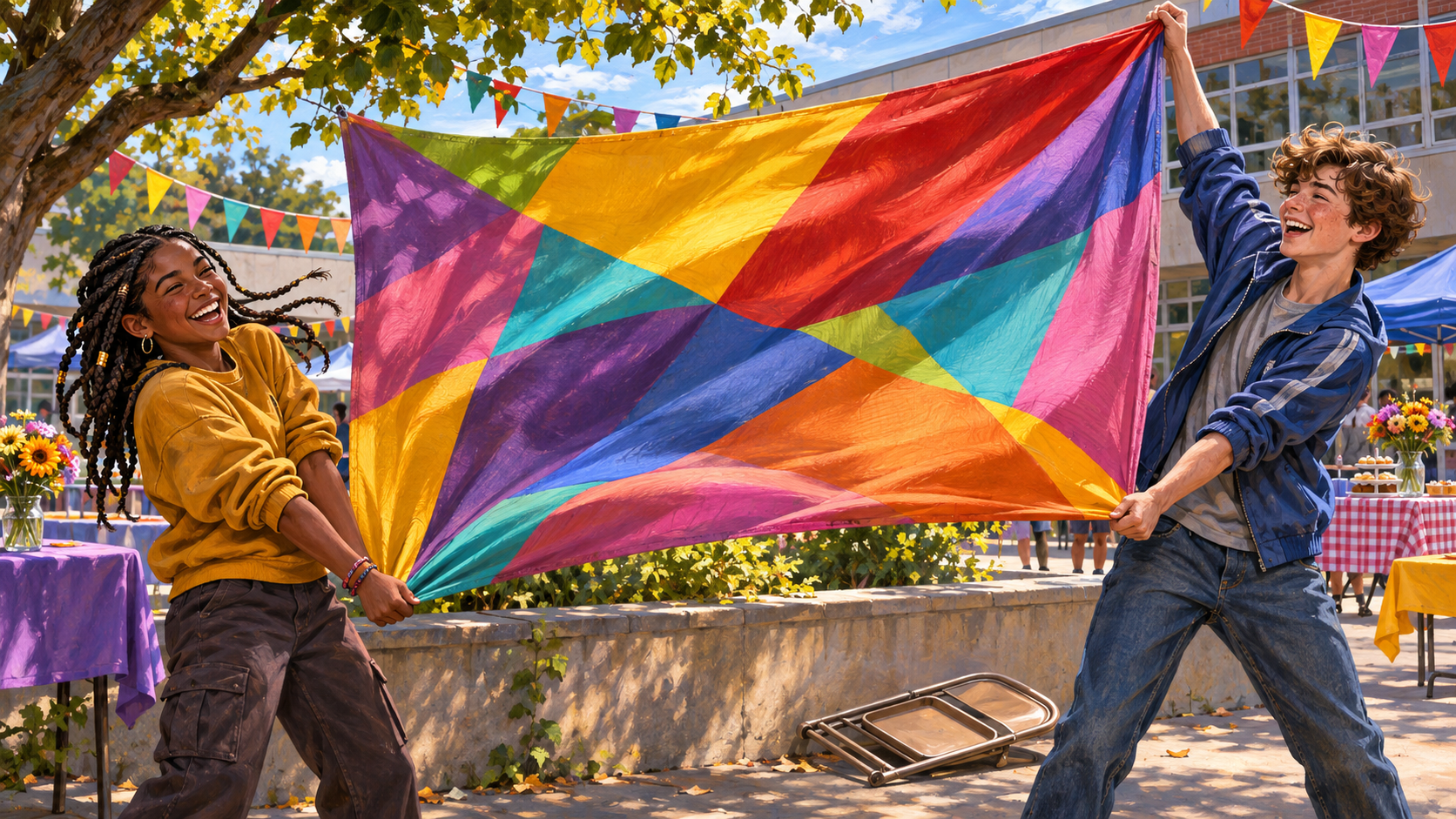
1. By noon, the school courtyard was a bowl of sunlight. Rosa and Kit carried their patchwork festival banner outside, certain that hanging it would be the easiest job of the afternoon.
2. The banner disagreed.
3. It was as restless as a puppy at an open gate. Whenever Rosa straightened one corner, another flapped over her shoulder. Kit caught the lower edge just before it swept a stack of paper cups from a table.
4. “We’ve made a beautiful kite,” he announced. “Unfortunately, nobody ordered one.”
5. Rosa tried to fold the cloth into a manageable strip. A gust snatched it open again. For a moment, the bright triangles swelled between them like the sail of a ship determined to leave without its passengers.
6. They had stitched the banner during three lunch periods. Rosa had imagined visitors admiring it above the courtyard entrance. She had not imagined spending the festival wrestling it.
7. “Again,” she said.
8. They folded, held, and adjusted. The wind undid their work.
9. “Call me Sisyphus,” Kit said. “Only my boulder has corners.”
10. Rosa laughed despite herself. She knew the myth: Sisyphus repeatedly pushed a stone uphill, only to watch it roll down again. Their task was beginning to feel equally permanent.
11. A teacher paused beside them. “Does it have to hang outside?”
12. Rosa looked toward the entrance hall. Through its glass doors, she could see a broad, empty display frame. The hall was also where visitors would collect their programs.
13. Ten minutes later, the banner hung indoors. Its colors glowed in the still air. Outside, the wind continued rearranging anything that had not been secured.
14. Kit stood back. “Our ship has reached port.”
15. Rosa smoothed one final fold. For the first time all afternoon, the banner behaved as though it had somewhere sensible to be.
Questions
1. The simile in paragraph 3 suggests that the banner is—
A. delicate and easily damaged.
B. constantly moving and difficult to control.
C. small enough to carry in a pocket.
D. frightened by the students.
2. Calling the courtyard “a bowl of sunlight” emphasizes its—
A. deep water.
B. cold temperature.
C. enclosed shape and abundant brightness.
D. complete silence.
3. Which word most strongly suggests sudden, forceful movement?
A. carried
B. paused
C. smoothed
D. snatched
4. What does the allusion to Sisyphus contribute?
A. It humorously compares their repeated failed efforts with an endlessly repeated task.
B. It suggests that Kit expects to discover treasure.
C. It reveals that Rosa wants to move a real boulder.
D. It explains why the festival takes place outdoors.
5. Describe the passage’s tone. Explain how two word choices or figures of speech establish it. (3 points)
Study the Responses
Expand examples and answers
Question 1 — Simile: The answer is B. The comparison emphasizes restless movement, matching the cloth’s flapping corners.
Question 2 — Metaphor: The answer is C. The courtyard is pictured as a container filled with light.
Question 3 — Connotation: The answer is D. Snatched suggests an abrupt, powerful action, unlike the more neutral carried.
Question 4 — Allusion: The answer is A. Each attempt is undone, recalling Sisyphus’s repeated task. The exaggerated comparison makes a minor difficulty amusing.
Question 5 — Supported analysis
Effective response:
The tone is playful. “The banner disagreed” treats the cloth as an uncooperative character, while Kit’s claim that his “boulder has corners” exaggerates their difficulty. Both choices invite readers to enjoy the mishap rather than view it as a disaster.
Response needing revision:
The tone is funny because funny things happen. This response needs specific language and an explanation of its effect.
Apply the Skills Independently
Directions: Read the original fantasy passage. Then answer Questions 6–10.
The Bell at Grey Pass
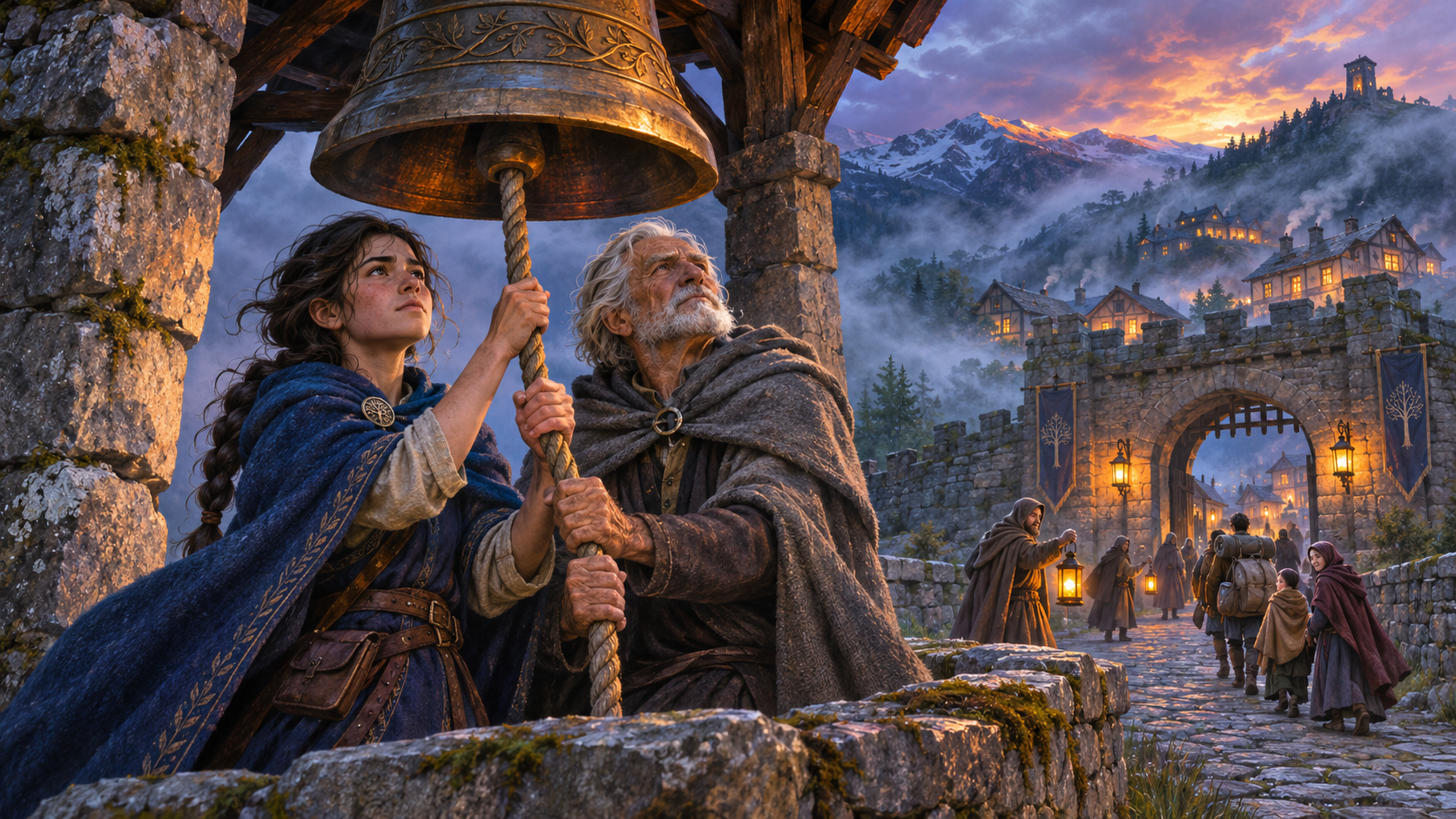
1. At dusk, fog covered the mountain road like a folded cloth. From the village gate, Nera could see neither the lower bend nor the travelers expected before nightfall.
2. Master Iven, keeper of the warning bell, listened beside her. “The road markers will be hidden,” he said. “We must sound the gathering call.”
3. Earlier that afternoon, the apprentices had boasted that they feared nothing on the mountain. Now a strange cry rose from the mist, and their bravado became ashes. All but Nera retreated toward the houses.
4. She wanted to follow. Instead, she entered the stone bell shelter with Iven. The rope was as stiff as a frozen root. When she pulled, the great bell shifted but did not sound.
5. “Again,” Iven said, placing his hands above hers.
6. Together they pulled. A low note traveled into the fog. They waited for its echo before sounding the next.
7. Nera’s arms trembled. “What if they hear us but cannot find the road?”
8. “A warning is to travelers what a handrail is to a stair,” Iven replied. “It cannot take the steps for them, but it can help them keep their way.”
9. At the third note, lanterns appeared inside the village. People gathered at the gate. Hearing the call, they understood that travelers might need help following the final stretch of marked road.
10. The apprentices returned with lanterns. Their eyes remained fixed on the fog, but this time they stayed beside the others.
11. At last, answering voices reached the shelter. One by one, the travelers emerged, guided toward the open gate by the villagers’ lights.
12. Nera released the rope. The strange cry sounded again. A shepherd entering the village looked toward the slope. “An owl,” he said.
13. Iven bowed his head to the villagers. “You have kept faith with those entrusted to this road.”
14. Nera watched the final traveler step inside. “Our silence would have been a locked gate,” she said.
Questions
6. “Their bravado became ashes” means that the apprentices’—
A. clothes caught fire.
B. confidence suddenly disappeared.
C. voices became louder.
D. plans became more detailed.
7. The comparison of the rope to “a frozen root” emphasizes that it is—
A. growing quickly.
B. hidden underground.
C. rigid and difficult to move.
D. burning Nera’s hands.
8. Explain the meaning of Nera’s final metaphor. Use events from the passage to support your answer. (3 points)
9. Iven’s analogy in paragraph 8 suggests that a warning—
A. offers guidance without completing the journey for someone.
B. removes every danger from a journey.
C. is useful only inside a building.
D. prevents travelers from making decisions.
10. Words and phrases such as “kept faith” and “entrusted” contribute to a tone that is—
A. mocking and dismissive.
B. casual and mischievous.
C. bitter and resentful.
D. dignified and respectful.
Remember: Explain what figurative language adds—not just what device the writer uses.
Teacher Answer Key
Expand examples and answers
| Question | Answer | Explanation |
|---|---|---|
| 1 | B | The puppy comparison emphasizes restless movement. |
| 2 | C | The metaphor pictures an enclosed space filled with light. |
| 3 | D | Snatched conveys sudden force. |
| 4 | A | The allusion exaggerates the repetition of unsuccessful effort. |
| 6 | B | Their boastful confidence vanishes when they hear the cry. |
| 7 | C | The comparison emphasizes rigidity. |
| 9 | A | A warning supports travelers without completing their journey. |
| 10 | D | The formal language treats duty with respect. |
5. Sample response: The tone is playful. Saying “The banner disagreed” personifies the cloth as stubborn, while describing it as a ship leaving without its passengers exaggerates the students’ struggle. These choices make their difficulty amusing.
Scoring: 3 points
• 1: Identifies a supported tone.
• 1: Explains one relevant word choice or figure of speech.
• 1: Explains a second example.
8. Sample response: Nera means that remaining silent would have denied travelers needed assistance, much as a locked gate prevents entry. The bell alerts villagers, who bring lanterns and guide the travelers toward safety. Without the call, that help might not have arrived.
Scoring: 3 points
• 1: Interprets the metaphor.
• 1: Cites the bell’s effect on the villagers.
• 1: Connects the travelers’ arrival to the interpretation.