
Read and Practice
A Name for the Display
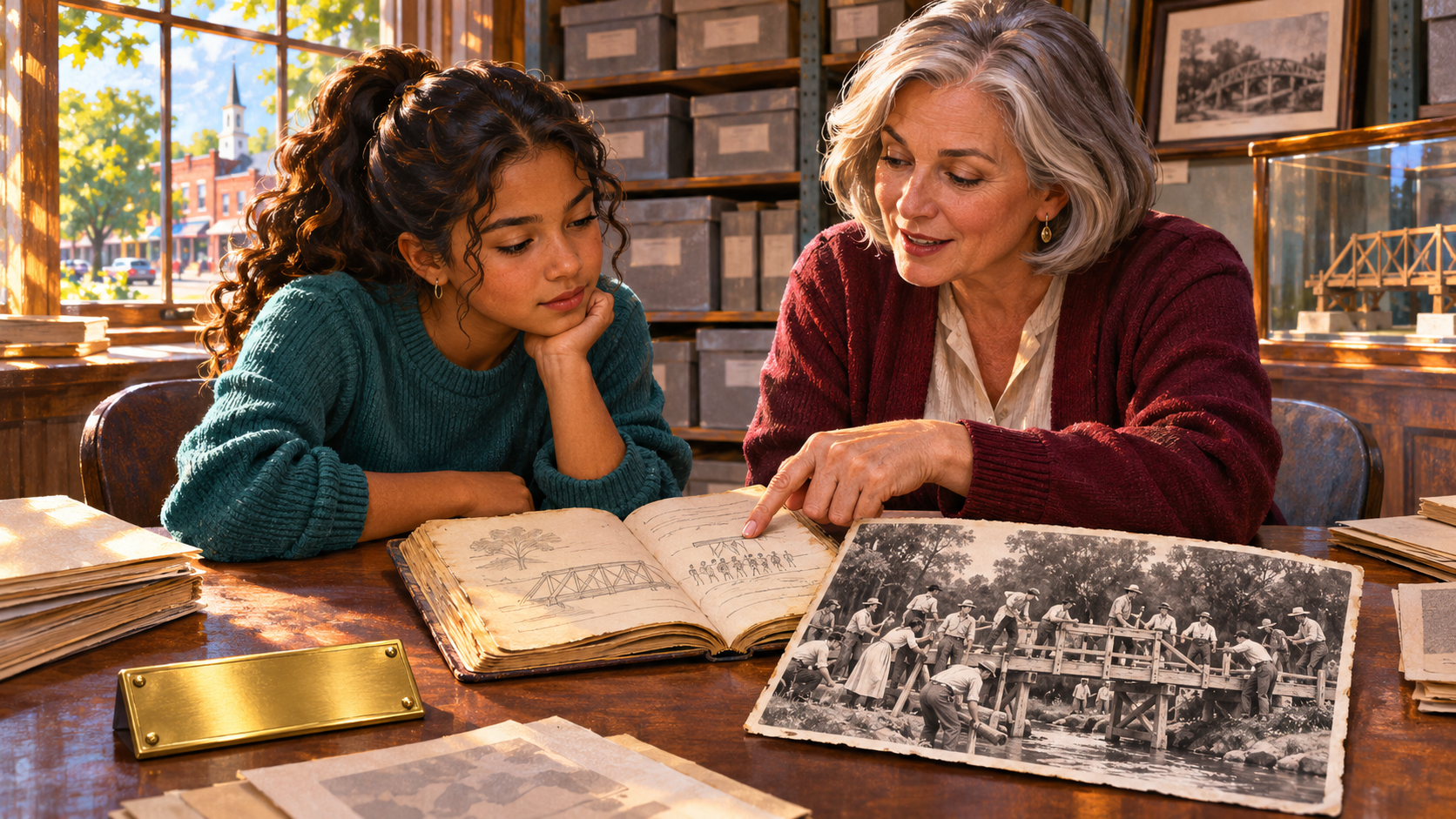
1. Alina polished the small brass plate until she could see a blurred reflection of her face. Tomorrow, she would finish her display for the town museum’s student history exhibition. Its centerpiece was a photograph of her great-grandfather standing beside the footbridge over Sable Creek.
2. Her family had always called him “the man who saved the bridge.” After a flood damaged the crossing, he had helped rebuild it. Alina had constructed a model and written a caption describing how one determined person restored the connection between two neighborhoods.
3. “Before we print the final caption, let’s examine the repair records,” said Ms. Rowan, the museum’s archivist.
4. Alina almost explained that she already knew the story. Instead, she followed Ms. Rowan into the archive room. They opened a notebook donated by a former town clerk. Beside lists of timber and nails were names, dates, and descriptions of work.
5. Alina found her great-grandfather’s name. She also found fourteen others. Two carpenters had designed the replacement supports. Neighbors had supplied wood, transported tools, and prepared meals. A shopkeeper had organized donations.
6. “But our photograph shows him beside the finished bridge,” Alina said.
7. Ms. Rowan placed another photograph on the table. In this one, a group stood along the unfinished railing. Alina recognized her great-grandfather near the middle. He was holding one end of a board while another worker supported the other.
8. “Was the family story wrong?”
9. “It preserved an important contribution,” Ms. Rowan replied. “It may not have preserved every contribution. We can keep his name without giving him everyone else’s work.”
10. Alina looked at the brass plate. She had spent her allowance on it. Its inscription named only her great-grandfather. Explaining a group effort would mean rewriting the caption and changing the arrangement she had carefully planned.
11. “Could we leave the caption and put the other names in a folder?” she asked.
12. “We could,” Ms. Rowan said. “What would most visitors take away?”
13. Alina pictured people reading the large caption and moving on. Almost nobody would open the folder. She asked to see the notebook again.
14. Together, they checked its entries against newspaper reports from the same month. Some details remained uncertain, but the records agreed that rebuilding had been a community effort. Ms. Rowan showed Alina how to distinguish confirmed information from a family recollection.
15. That evening, Alina called her grandmother. She expected disappointment. Instead, her grandmother asked whether the notebook mentioned a woman named Ruth. “My grandfather used to say nobody worked hungry when Ruth was around,” she explained.
16. Alina added the recollection to her notes, clearly identifying its source. It did not replace the records, but it helped her imagine the people behind them.
17. At the exhibition, the revised display included the group photograph, a short account of the rebuilding, and the names the records confirmed. Her great-grandfather remained part of the story. He simply no longer stood alone.
18. The brass plate rested beside the notebook reproduction. Beneath it, Alina had explained why the display’s title had changed.
19. A visitor studied the model. “So who saved the bridge?”
20. Alina pointed to the photographs. “Let me show you.”
Questions
1. Write an objective summary. Include the setting, central conflict, important decisions, and outcome. (3 points)
2. Which sentence most clearly shows Alina accepting the need to investigate further?
A. “Alina polished the small brass plate.”
B. “She asked to see the notebook again.”
C. “She had spent her allowance on it.”
D. “Her family had always called him ‘the man who saved the bridge.’”
3. What can readers infer from Alina’s decision to revise the display?
A. She no longer values her family’s history.
B. She wants to avoid speaking to museum visitors.
C. She becomes willing to place accuracy above her original plan.
D. She believes photographs provide no useful information.
4. Ms. Rowan most closely resembles which traditional character type?
A. A trickster who creates confusion for personal gain
B. A rival who tries to defeat the main character
C. A wanderer searching for a home
D. A mentor who guides someone toward understanding
5. Which statement best expresses a theme?
A. Honoring someone does not require overlooking other people’s contributions.
B. Family memories should always replace written records.
C. Historical displays are valuable only when they celebrate one hero.
D. Changing a plan usually weakens the finished work.
6. Which detail best supports Ms. Rowan’s reliability as a guide?
A. She works in a room containing old notebooks.
B. She asks Alina to compare notebook entries with newspaper reports.
C. She stands beside Alina at the archive table.
D. She allows Alina to keep the brass plate.
7. What most directly challenges Alina’s original account?
A. Her grandmother remembers a woman named Ruth.
B. A visitor asks who saved the bridge.
C. The notebook records work completed by numerous people.
D. The brass plate reflects Alina’s face.
8. What does Ms. Rowan’s dialogue in paragraphs 9 and 12 reveal about her character? Support your answer with details. (3 points)
Points earned: ______ / 12
Teacher Answer Key
Expand examples and answers
1. Sample summary: While preparing a museum display, Alina discovers that her great-grandfather helped rebuild a bridge alongside numerous other residents. Although she initially wants to preserve her single- hero account, Ms. Rowan guides her through additional evidence. Alina revises the display to recognize the community effort while retaining her great-grandfather’s contribution.
Scoring: 3 points
• 1: Establishes the museum project and conflict.
• 1: Explains the investigation and Alina’s decision.
• 1: Includes the outcome in concise, objective language.
| Question | Answer | Explanation |
|---|---|---|
| 2 | B | Requesting the notebook again shows a willingness to investigate. |
| 3 | C | She changes a personally meaningful plan to reflect the evidence. |
| 4 | D | Ms. Rowan guides rather than dictates or deceives. |
| 5 | A | The revised display honors an individual within a collective effort. |
| 6 | B | Comparing independent records demonstrates careful investigation. |
| 7 | C | The notebook directly contradicts the single-person account. |
8. Sample response: Ms. Rowan is fair-minded and thoughtful. She says Alina can preserve her great-grandfather’s contribution without giving him credit for everyone’s work. Instead of ordering a revision, she asks what visitors would learn from the proposed display, encouraging Alina to consider its effect.
Scoring: 3 points
• 1: Identifies a defensible trait.
• 1: Explains the significance of paragraph 9.
• 1: Explains the significance of paragraph 12.