
Build Your Skills
Q: How do characters, setting, and plot develop a theme?
A: A theme is an insight about life or human experience that a literary work develops. A topic, such as ambition, names a subject. A theme expresses a complete idea about that subject, such as Ambition becomes harmful when it prevents people from recognizing consequences. To identify a theme, trace the relationship between a character’s goal, the obstacles the character encounters, and the choices that follow.
Ask:
• What does the character want at first?
• How does the setting create challenges or opportunities?
• Which events challenge the character’s assumptions?
• What does the ending reveal about the character’s choices? A character does not always learn a lesson. Sometimes readers recognize a truth that the character fails to understand.
Q: How do dialogue and incidents move a story forward?
A: Dialogue can introduce a disagreement, reveal information, or challenge a character’s beliefs. An incident can interrupt a plan or force a decision.
Use this pattern to explain their effects:
Dialogue or incident → character’s response → consequence
For example, a teammate’s warning might cause a character to reconsider a risky plan. Explain both what the character hears and what changes because of it.
Q: How can a modern story draw on traditional literature?
A: Writers may adapt an older work’s character types, themes, or patterns of events. They can preserve part of the pattern while changing the setting, conflict, or outcome. A modern character might resemble an overconfident figure from a fable, for example, but respond differently after making a mistake.
A strong comparison explains:
• A specific similarity
• An important difference
• How that difference changes the story’s meaning
Read and Practice
Directions: Read the story and the traditional-story connection. Then answer Questions 1–3.
The Slow Test
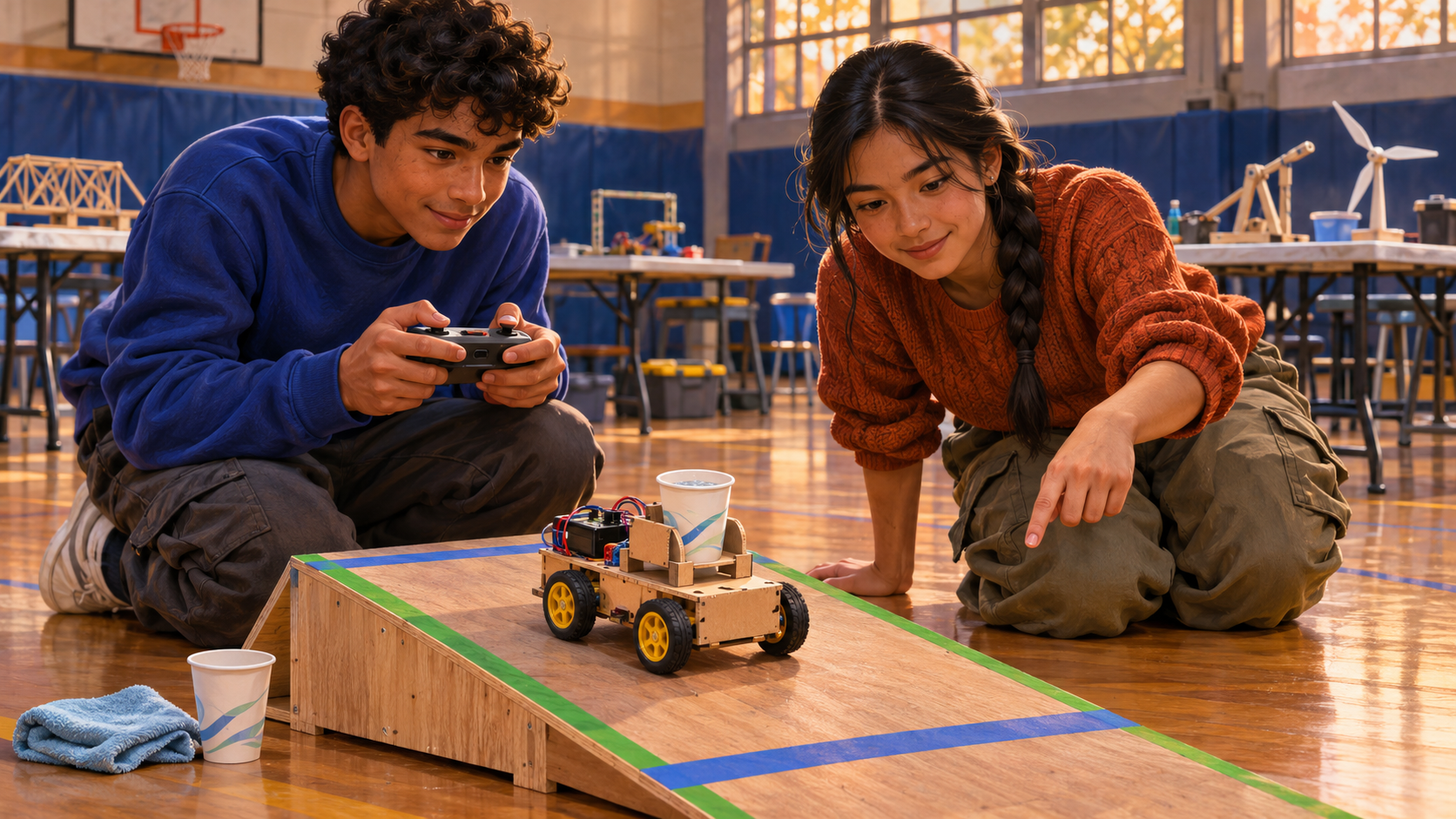
1. By four o’clock, the school gym had become a maze of extension cords and folding tables. Tomorrow’s engineering showcase would include bridges, windmills, and a delivery robot designed to carry a cup of water over a short obstacle course. Nico crouched beside the robot and increased its speed setting.
2. Across the practice ramp, Mara checked a page of test results. She had spent the afternoon adjusting the robot’s cup holder and recording how much water remained after each trip.
3. “Try the lower setting first,” she said. “We haven’t tested this ramp.”
4. Nico grinned. “We already know it can crawl. Let’s find out what it can do.”
5. Their teacher had explained that successful deliveries mattered more than finishing quickly. Still, Nico pictured the audience watching their machine race across the gym. He had assembled its motor system in one afternoon. Surely he did not need another hour of slow practice.
6. He pressed the controller. The robot shot forward, climbed the ramp, and bounced as its front wheels crossed the top. Water leaped from the cup. At the bottom, the robot turned sharply and tipped the cup onto the floor.
7. Mara reached for a cloth. Nico examined the wheels.
8. “The ramp’s uneven,” he said.
9. “Yes,” Mara replied. “That’s why it’s part of the course.”
10. Nico reset the cup and tried again, slightly reducing the speed. This time, the robot reached the turn before spilling. He glanced at the clock. The custodian would close the gym in forty minutes.
11. “We could demonstrate it without water,” he suggested.
12. Mara stopped wiping the floor. “Then we’d be demonstrating a different problem from the one we were asked to solve.”
13. Nico looked at her test sheet. Beside each trial, she had noted the speed, the cup’s position, and where the wheels slipped. He had thought she was delaying the exciting part. Now her careful columns contained information he did not have.
14. “What would you change first?” he asked.
15. Mara moved the cup holder closer to the center. Nico lowered the speed. Together, they watched the robot climb the ramp, descend, and complete the turn. Only a few drops escaped.
16. Nico reached toward the speed control, then paused. “Same setting again?”
17. “Same setting,” Mara agreed.
18. They repeated the course five times, adjusting one thing between trials. On the final run, the cup arrived with its water still inside.
19. The next morning, another team’s machine finished faster. Nico felt a brief sting of disappointment. Then their own robot crossed the finish line with a full cup, and Mara entered the result on her sheet.
20. A visitor asked how they had made it reliable. Nico pointed to the recorded trials. “We stopped guessing,” he said, moving aside so Mara could explain.
Traditional-Story Connection: “The Tortoise and the Hare” In this fable, a fast hare is so confident of defeating a tortoise that he stops to rest during their race. The tortoise continues steadily and reaches the finish first. The hare’s natural advantage cannot make up for his careless choices.
1. Which statement best expresses a theme of “The Slow Test”?
A. Careful testing and a willingness to learn can accomplish more than confidence alone.
B. A project is successful only when it finishes faster than competing projects.
C. People should avoid tasks that do not come easily to them.
D. Working with a partner prevents people from developing their own ideas.
2. How does the modern story adapt the overconfident character found in “The Tortoise and the Hare”?
A. Nico depends on speed at first, but he changes his approach before the final demonstration.
B. Mara stops working because she assumes that Nico will finish the project.
C. Nico refuses to continue after another team finishes faster.
D. Mara wins a race by hiding information from her partner.
3. How does Mara’s statement in paragraph 12 help move the plot toward its resolution? Explain Nico’s response and its consequences. Use at least two details. (3 points)
Examine the Responses
Expand examples and answers
Question 1: Connecting story elements to theme
The correct answer is A.
| Story element | Contribution to the theme |
|---|---|
| Character | Nico initially trusts his ability more than the testing process. |
| Setting | The ramp and turn expose weaknesses that a smooth floor would not reveal. |
| Plot | Failed trials lead Nico to seek Mara’s knowledge and test systematically. |
| Ending | Their robot delivers successfully even though it is not the fastest. |
Together, these details support a theme about preparation and openness to learning.
Question 2: Analyzing an adaptation
The correct answer is A. Like the hare, Nico assumes that speed gives him an advantage. However, the modern story changes the pattern: Nico recognizes his mistake and adopts a more careful method before the final event. His change allows the story to emphasize learning rather than simply the consequences of overconfidence.
Question 3: Explaining the effect of dialogue
Effective response:
Mara’s statement challenges Nico’s suggestion that they demonstrate the robot without water. It reminds him that speed is not the actual purpose of the project. He then examines her test results and asks what she would change. Their repeated trials lead to a successful delivery.
Response needing revision:
Mara disagrees with Nico because she wants the robot to carry water. The second response identifies the disagreement but does not explain how it changes Nico’s actions or leads to the outcome.
Apply the Skills Independently
Directions: Read the story and the traditional-story connection. Then answer Questions 4–7.
One More Minute
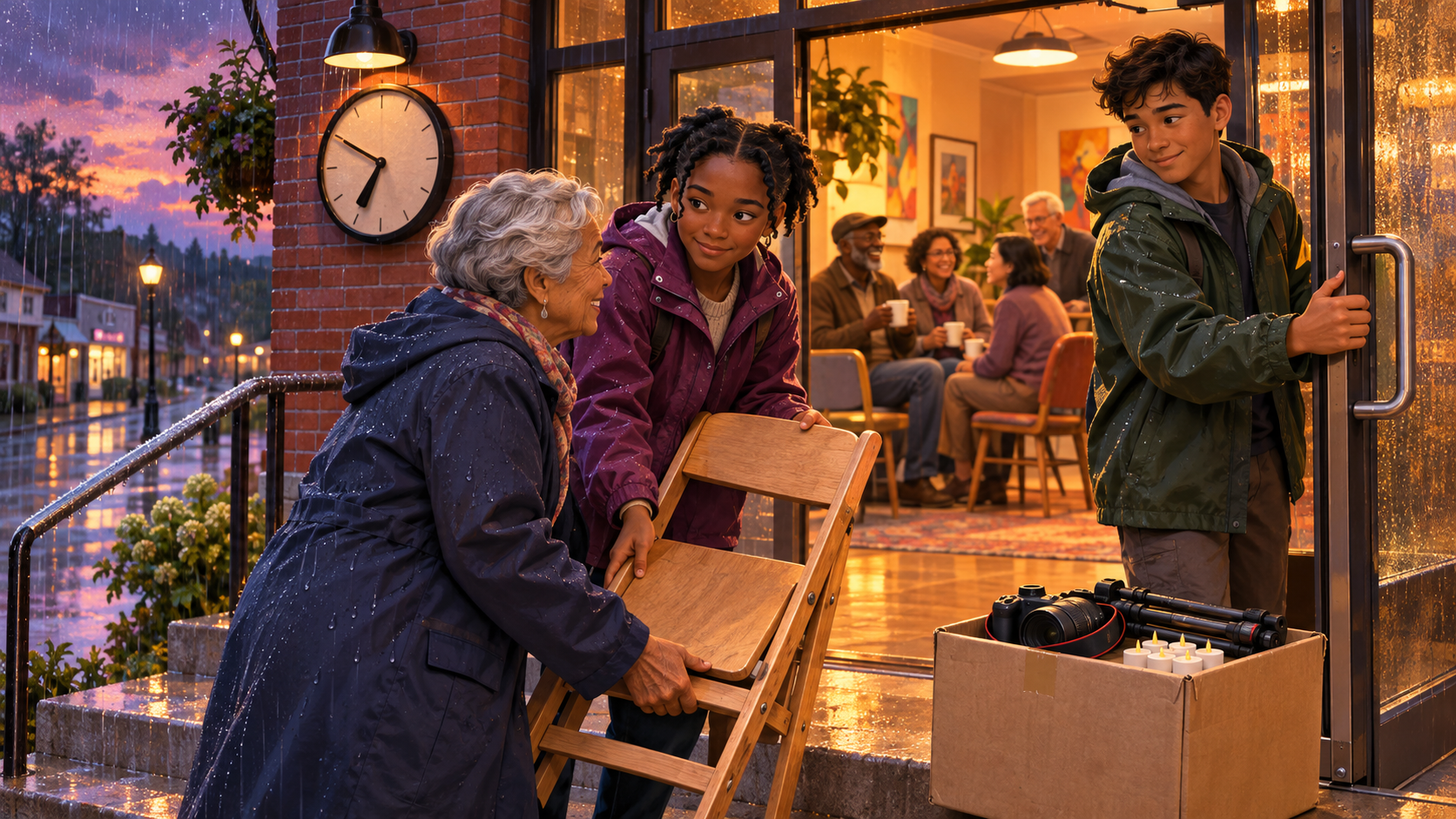
1. Imani had borrowed a camera, drawn a storyboard, and persuaded her cousin Theo to spend Saturday helping her film. The community arts center needed a short video for its fundraising page. If she could capture the place perfectly, she thought, people would understand why it mattered.
2. At the afternoon pottery workshop, she filmed a child lifting a crooked bowl from a table. His grandmother laughed and held it up proudly.
3. “Again?” Imani asked. “Someone walked behind you.”
4. They repeated the moment. This time, the grandmother looked toward the camera before laughing. Imani frowned at the screen. The background was clear, but something about the first version had been better.
5. Throughout the afternoon, she requested another entrance, another greeting, another sweep of a paintbrush. Theo carried the equipment and checked the time.
6. “We still need the evening room,” Imani said. “The lights look warmer after sunset.”
7. That room opened every Saturday for neighbors who wanted company, board games, or help with small projects. By six, people were arriving with knitting bags and containers of food. Imani positioned a row of battery-powered tea lights along a shelf.
8. “Could everyone wait in the lobby for one minute?” she asked. “I need an empty-room shot.”
9. A minute became five. A chair stood crooked. A reflection appeared in the window. The room was nearly right, but Imani could always see one more thing to fix.
10. Theo looked through the doorway. “Mrs. Hale’s shuttle is delayed. She’s been standing out there.”
11. “There are chairs in the lobby.”
12. “They’re all taken.”
13. Imani adjusted the camera. “I’m almost finished.”
14. Outside, rain began ticking against the glass. A volunteer entered to collect mugs, then stopped when Imani raised her hand.
15. “Just one more minute.”
16. The volunteer glanced toward the lobby. “People are asking when they can come in.”
17. Imani finally pressed record. The camera moved smoothly across the glowing shelf, the polished tables, and the neatly arranged chairs. Nothing interrupted the shot.
18. She played it back. The room looked beautiful. It also looked closed.
19. From the lobby came a burst of laughter, followed by the scrape of someone offering a seat. On the screen, every chair remained empty.
20. Theo stood beside her. “What are we asking people to support?”
21. “The center.”
22. He looked from the screen to the doorway. “Which part?”
23. Imani did not answer immediately. All afternoon, she had moved people aside to make the center look welcoming.
24. She lowered the camera. “Help me carry a chair.”
25. They found a folding chair in the storage cupboard. At the entrance, Mrs. Hale was watching the rain beyond the sheltered steps. Imani brought the chair over and apologized.
26. “We can sit inside,” she said. Theo held the door as they helped Mrs. Hale move the chair into the room.
27. Soon, mugs crowded the tables. Someone’s knitting rolled beneath a chair. A boy explained the rules of a card game twice, then admitted he had forgotten one himself.
28. Imani reached for the camera, but stopped before switching it on. “Would anyone mind if I filmed a little of this for the fundraiser?”
29. Several people agreed. Mrs. Hale waved her toward the table. “You’ll have to work around the crumbs.”
30. The finished video included an uneven bowl, an interrupted greeting, and Theo laughing as he retrieved the runaway knitting. Imani kept a few seconds of the empty room, followed by the moment people entered it.
31. Before sending the video, she watched the ending once more. Mrs. Hale was telling a story, and a listener leaned closer to hear her. Imani’s camera drifted slightly to one side.
32. She left it that way.
Traditional-Story Connection: King Midas In the Greek myth, King Midas wishes that everything he touches will turn to gold. At first, he celebrates his new power. He soon discovers that turning ordinary things—including food and drink—into gold makes them useless to him. His prized gift prevents him from enjoying necessities, and he seeks to undo it.
4. How does Imani’s understanding of a successful video change? Explain how Theo’s dialogue and another incident contribute to that change. Use at least two details. (3 points)
5. Which statement best expresses a theme of the story?
A. A flawless appearance can become less valuable than the human experiences it is meant to represent.
B. Technology prevents people from forming lasting relationships.
C. Creative projects succeed only when their makers work alone.
D. Public spaces are most useful when they remain quiet and orderly.
6. Which incident most directly reveals that Imani’s pursuit of the perfect shot is interfering with the center’s purpose?
A. Imani borrows a camera and prepares a storyboard.
B. Theo carries the equipment during the afternoon.
C. Neighbors wait outside the room while Imani films its empty chairs.
D. Imani reviews the completed video before sending it.
7. How does “One More Minute” transform a pattern from the King Midas myth?
A. Both characters seek something they value, but Imani’s pursuit makes a welcoming space temporarily unavailable rather than turning useful objects into gold.
B. Both characters receive magical powers that allow them to control other people.
C. Imani avoids Midas’s mistake because she recognizes the consequences before anyone is inconvenienced.
D. Unlike Midas, Imani concludes that having something impressive matters more than meeting people’s needs.
Test-Taking Strategies
1. State a theme as a complete idea. Move beyond a topic such as success or perfection. Explain what the story suggests about that topic, then check the idea against the beginning, middle, and ending.
2. Trace what changes after important dialogue. Identify what a character hears, how the character responds, and what happens next. This chain helps explain how a conversation propels the plot.
3. Distinguish an explanation from an incident. A character may describe a problem, but an event can demonstrate it. Read carefully when a question asks how action reveals an idea.
4. Compare patterns, not just surface details. Characters do not need similar names, jobs, or surroundings to share a traditional pattern. Compare their goals, decisions, consequences, and outcomes.
Remember: A strong comparison explains both what the modern story preserves and what it changes.
Teacher Answer Key
Expand examples and answers
Guided Practice
1. A Nico’s confidence produces unsuccessful trials. Careful testing, combined with his willingness to learn from Mara, makes the robot reliable.
2. A Nico resembles the overconfident hare at first, but the modern story gives him an opportunity to change before the final demonstration.
3. Sample response: Mara points out that removing the water would avoid the assignment rather than solve it. Her statement causes Nico to reconsider his approach. He studies her recorded results and asks for advice. They then adjust the robot and repeat the course until it delivers the water successfully.
Scoring: 3 points
• 1 point: Explains how Mara’s statement challenges Nico’s proposed solution.
• 1 point: Supports Nico’s changed response with a specific detail.
• 1 point: Explains how the response leads toward resolution, using another detail.
Independent Practice
4. Sample response: At first, Imani believes a successful video must look flawless, so she repeatedly interrupts activities and keeps the evening room empty. Seeing the beautiful but lifeless recording makes her question that goal. Theo’s question, “What are we asking people to support?” helps her recognize that the center matters because of its people. She opens the room and makes a video that preserves genuine interactions, including small imperfections.
Scoring: 3 points
• 1 point: Explains the change from visual perfection to representing genuine community life.
• 1 point: Explains the influence of Theo’s dialogue with accurate evidence.
• 1 point: Explains the influence of another incident with accurate evidence.
5. A The empty-room recording looks polished but excludes the people who give the center its value. Imani’s final choices show her revised priorities.
6. C The waiting neighbors and empty chairs demonstrate a contradiction: Imani is preventing people from using the space while trying to show how welcoming it is.
7. A Both stories follow a pattern in which pursuing something desirable interferes with a more important benefit. The modern story replaces a magical transformation with ordinary decisions about filming and access to a community space.